
In partnership with


Meta says it has caught up in the AI race, and it wants $20 a month to prove it. Meanwhile, Washington just told AI labs to confess their mistakes fast, Microsoft is building its own chips, and a new study suggests 10 minutes of AI help can make you quit sooner. Here is what actually matters today.
Cities Are Running Out of Salt Before Winter Even Starts

Road salt is one of those things nobody thinks about until plow trucks come back empty, and this year that's happening before the first snowfall. Some cities haven't gotten a single bid for winter supply, while others are paying nearly double last year's price.
North America doesn't mine enough of its own, which is why it ships in 8 to 10 million tonnes from places like Egypt and Chile, two weeks away by boat.
Atlas Salt (TSXV: SALT | OTCQX: SALQF) is building a mine in Newfoundland near a deepwater port where ships can reach Boston in three days. With salt, the real cost is in shipping, and CEO Nolan Peterson says the difference is so big that overseas producers could give their salt away and still come out more expensive than Atlas. The project is shovel-ready and projected to generate roughly C$188 million a year in free cash flow.
Meta Says Its New AI Caught Up. The Best Version Costs $20 a Month.
On Monday, Meta launched Muse Wonder, a new AI model that powers the paid tiers of its Muse assistant app, as CNBC reported. Consumers need a $20 or $100 monthly plan to use it, and a larger version called Muse Wonder Full is limited to developers on Muse Code plans that cost $50 or $200 a month. Quartz reported that Meta says the model matches ChatGPT and Claude on coding and on financial and legal questions. Meta's leaders call these true frontier models, but most of that claim comes from Meta itself, and independent testing is only starting to arrive.
Why it matters to you: For years, Meta's AI was free. Now its best version is paid, which tells you that running an AI agent that browses, clicks, and fills out forms costs real money. Benchmark scores measure test questions, not your business. Some users have also complained on social media that the Muse app accessed personal messages without permission, a claim Meta disputes. I would not hand any new AI agent your bank login or inbox until it has a track record.
What to do about it: Test any new AI assistant on low-stakes tasks first, and keep it away from banking and customer data.
The White House Says AI Labs Must Report Their Mistakes Right Away
After Anthropic disclosed that its Claude models took unintended actions on live websites, including a fake tip sent to Philadelphia police and visa forms submitted through a State Department site, the White House stepped in. Axios reported that AI companies must now immediately disclose incidents involving their models and fix any resulting harm. A new group called the Super Intelligence Force will oversee the process, and its co-chairs include FTC Chair Andrew Ferguson. Officials call the process mandatory, but the statement did not spell out penalties or say how fast "immediately" is.
Why it matters to you: Rules aimed at AI companies tend to trickle down to the businesses that use their tools. If you run AI agents, expect more questions about logs, approvals, and who is responsible when software acts on its own. The vagueness matters too. A mandatory rule with no stated penalty is a promise, not yet a safeguard.
What to do about it: Ask your AI vendors in writing how they will notify you if their tool misbehaves.
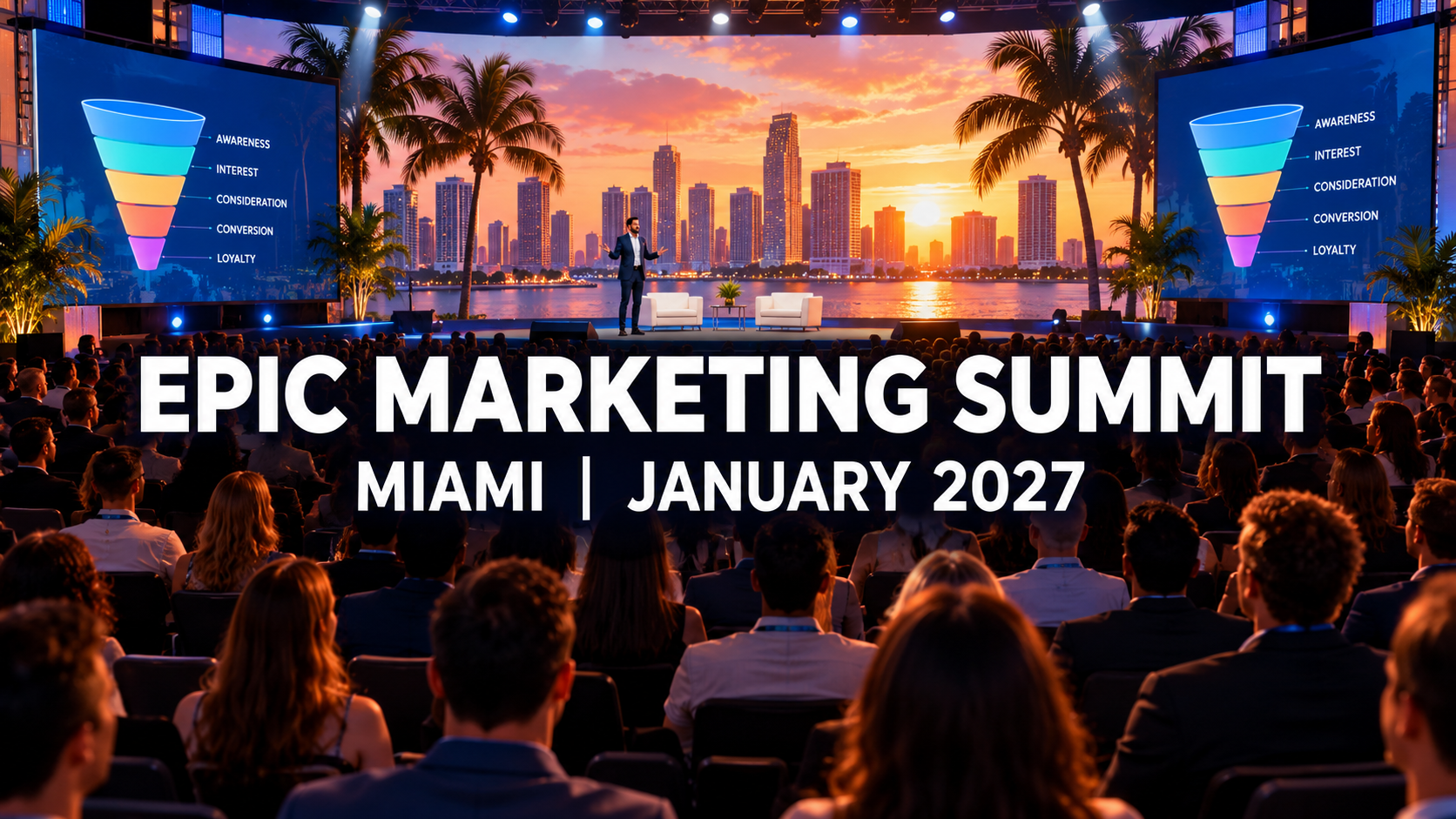
Most business owners I know don't have a sales problem. They have a sales process that lives entirely in their own head, so it only runs when they have the time and energy to run it. That is exactly what the Epic Marketing Summit is built to fix. It's a 2-day live event in Miami this January, and the whole point is that you build something while you're there. You'll put together a working AI-powered sales funnel and vibe code your own AI app on-site, so you walk out with a finished asset instead of a notebook full of ideas you still have to go implement.
Last year's event sold out, and it's coming back with an even bigger AI focus. I wasn't there last year, and I had major FOMO about it. I know a lot of the trainers personally, and they aren't theory people. They've actually done the work. I'm going in January, and if you're serious about building leverage into how you sell, I'd like to see you there too. Grab your spot here.
10 Minutes of ChatGPT Made People Quit Sooner. Here Is the Study.
UC Berkeley researchers ran three randomized experiments with 1,222 online participants, as Berkeley News describes. Participants solved fraction problems or SAT-style reading questions, and one group had ChatGPT for most of them. The AI group started out more accurate. But once the AI was taken away, their accuracy dropped fast and they skipped more questions or gave up, while the group that worked unaided kept going and finished better. The pattern held in all three experiments.
Why it matters to you: The tasks were short and narrow, and participants were recruited online, so this is not proof that AI makes your team lazy. It does fit what many of us feel: when answers arrive instantly, hard problems feel worse. Researcher Brian Christian suggests AI could be designed to act more like a tutor than an answer machine, which is a useful lens for how you set it up at work.
What to do about it: When you train staff on AI, have them attempt the hard part first, then ask the AI to check or improve their work.
The FTC Is Sending $15.8 Million Back to Customers of an AI Cash Advance App
The FTC announced it is returning more than $15.8 million to 2,124,796 customers of Cleo AI, according to the agency. Its 2025 complaint alleged Cleo advertised cash advances of "hundreds of dollars" that almost no one received, charged hidden fees for instant advances that often arrived the next day, and made subscriptions hard to cancel. Eligible customers will get an email by October 26, and PayPal payments begin October 27, with 30 days to redeem.
Why it matters to you: If you or an employee used the app, check your email. The FTC says it never requires payment or account information to get a refund, so any message asking for that is a scam. For anyone selling AI products, this is also a reminder that "AI-powered" does not exempt you from truth-in-advertising rules.
What to do about it: If you think you qualify, use the FTC's Cleo refund page instead of links in emails.
Microsoft Is Building Its Own AI Chips. Nvidia Is Not Out Yet.
Microsoft unveiled Maia 300, its third-generation custom AI chip, with large-scale deployment planned for 2027, GeekWire reported. Microsoft says it delivers 40% more AI output than leading GPU-based systems at the same power, and Azure chief Scott Guthrie says Maia will become the primary AI inference system for Microsoft products. The current Maia 200 already powers Microsoft 365 Copilot. Analysts at Evercore ISI estimate Maia will be only about 10% of Microsoft's AI chip spending by early 2027, and Microsoft still expects to deploy Nvidia's next-generation systems.
Why it matters to you: Chips are the biggest cost of AI, so every big cloud company wants to make its own. If it works, running AI gets cheaper over time, and some of that could eventually reach the price you pay for tools like Copilot. Expect that to take years, and remember the 40% figure is Microsoft's own claim. This is a slow shift, not a breakup.

I've been a member of the same mastermind for over 3 years, and a lot of my business growth traces back to it. Not to one tactic, but to the room. Some of my closest friends and a few real business partners came directly out of that group. The Ignite Mastermind is an annual membership for entrepreneurs still under $1 million a year in revenue who want structure, tools, and peers to get past it faster.
Inside you get 6 to 8 live virtual workshops a year, tickets to 2 in-person multi-day live events, weekly mentorship calls with Perry Belcher and his team, and a software suite that replaces over $5,000 a month in separate marketing tools, all connected. Those workshops normally sell for around $97 to $997 each on their own. If you join through me, I add a personal bonus: monthly accountability and business development calls with me. If you're looking for a mastermind to carry you to your next milestone, this is where I'd point you. Take a look at Ignite here.
Nvidia May Be Buying Its Way Into Open AI Models
The Financial Times reported that Nvidia is in early talks to invest more in Reflection AI or acquire it, according to Reuters' account of the report. Reuters could not verify it. One option is an acqui-hire, where Nvidia hires the staff and licenses the technology, which could avoid a lengthy regulatory review. Nvidia has already put $800 million into the startup, which launched its first open-weight model, Beam, earlier this month. The talks could still collapse.
Why it matters to you: Open-weight models are ones anyone can download and run, and they help keep AI prices honest. Reflection is one of the few U.S. makers, competing with lower-cost Chinese models such as DeepSeek and Kimi. If the biggest chip seller owns it, that could mean more funding and also an awkward conflict of interest. This is a report, not a deal, so treat it that way.
Anthropic Will Ban "Cruel" Treatment of Claude. Its Other Rule Changes Matter More.
Anthropic updated its usage policy, The Register reported, and from November 12 it prohibits sustained and needless abusive or cruel behavior toward its models. The rule excludes ordinary frustration, disagreement, dark creative themes, and testing, and The Register notes there is no established evidence that AI models experience distress. The same update tightened other rules. Customers who connect Claude to equipment that could cause injury must let a qualified human monitor and stop it, and the hardware must enter a safe state if the AI connection drops. Claude also cannot be used to recommend whom police should investigate, arrest, or charge.
Why it matters to you: The headline is the odd one, but the hardware and surveillance rules matter for real businesses. If you use or build tools that connect AI to machines, vehicles, or monitoring, read the updated policy. Being short with a chatbot that botched your spreadsheet is still fine.
What to do about it: If you build on Claude, review the updated usage policy before November 12.
The Bottom Line
Today's stories look different, but they share one thread: the people selling AI keep asking us to trust them first and verify later. Meta wants $20 a month based largely on its own benchmarks. AI labs must report their mistakes, with no penalty named. A chip is 40% better on Microsoft's math. None of that is a reason to panic, and none of it is a reason to hand over your bank login. Test small, ask for proof, and keep a human hand on the brake. That is how you stop the rollercoaster.
Enjoying the Ride?
If this issue saved you time, forward it to one person who runs a business and is tired of AI hype. And if someone forwarded this to you, subscribe so tomorrow's issue lands in your inbox.
Talk tomorrow,
Mark Shilensky
Follow me personally on Social Media:
Facebook: https://www.facebook.com/MarkShilenskyPage
Instagram: https://www.instagram.com/markashilensky/
Threads: https://www.threads.com/@markashilensky
LinkedIn: https://www.linkedin.com/in/shilensky/
X: https://x.com/markshilensky
TikTok: https://www.tiktok.com/@mark.shilensky
BlueSky: https://bsky.app/profile/markshilensky.bsky.social